Thursday, 26 April 2012

Honda Hawk Streamliner Week – Post: 05


The Motorcycle World Speed Record?

It is the big day, and the Honda Hawk needs to show the world that it is ready to fly into the history books, and take the motorcycle world speed record. The FIM observer has just been flown in from Europe, and he stands next to maybe the greatest American pre-World War II motorcycle racer, Joe Petrali, here on the salt flats of Bonneville. Joe Petrali is here as timekeeper for the USAC, and together with FIM they are the ones who will perpetuate this great event in the years to come (if succesful).

Left: FIM observer Right: Joe Petrali 


Everything on the Honda Hawk is being checked and re-checked before pilot Jon McKibben will take the first test run down the salt. The side panels is sitting next to the Hawk, as the Honda mechanics makes the final adjustments to the speed machine. Anytime from now could be "Go" for the first run of the day...


Jon McKibben's instrument panel looks like it was taken out of an airplan. The far left gages read the cylinder head temperatures of the two CB750s, and the two gages on the center right read pressures to the two stabilizing struts that are deployed to keep the Honda Hawk upright as it slows down and stops. Top right is the clutch servo-assist cylinder pressure, the lower right is the turbocharger manifold pressure with the fire extinguisher knob visible below. Not seen [on the picture below] is a panel between the rider’s legs with two columns of lights, one for each gear plus neutral. Because both transmissions were shifted with a common linkage, McKibben would check after each shift that both gears were engaged before releasing the clutch lever. On one run they did get out of synch and the run had to be aborted.


Jon McKibben gets into the cockpit of the Hawk, and the crew push the Hawk to a running start... But already on this first run it is clear that something is wrong!The steering geometry is not stable, and the steering trail is wrong. It is clear that the front ends four-bar linkage steering design, is not working as intented. Reaction Dynamics wants to adjusted the trail, but, the pressure from above is very much “don’t just stand there – do something”. After several failing attempts to run the bike, due to instability, it is decided to revert to a proven “center-point steering” design such as Don Vesco had developed for his successful record run in 1970 with his Yamaha. 


Dick Keller then calls Don Vesco, and asked for the bearing part number he had used – which he gladly provids. Dix Erickson then drives back to the American Honda shop in Gardena to machine the hub and pick up the bearings. And with minimal machining of the existing parts, there is now a possibility that the Honda Hawk will run straight.

But the Hawk is followed by bad luck... The Bonneville salt flat was not smooth in 1971, and at high speeds the rear wheel would lose traction and sometimes became slightly airborne after hitting a rut or wavy portion of the surface. When this happened under power the engines would rev up quickly, before McKibben could roll off the throttle, and the tire would speed up. On several occasions the high revs resulted in engine damage. On other occasions the over-speeding tire would impact the surface again with a sudden change in speed due to the tire immediately slowing down to match the ground speed and over-stress the drive chain. Drive train failures were of two types, a breaking drive chain, or a chain link separating and penetrating the gearbox casting.  


The Honda Hawk made several runs in the high 200s, and made one 286.556 mph run in 1971. But with the FIM two hour rule, stating that you need to make two consecutive runs to make a record, the Honda Hawk team never manage to make a return run in the two hour window given by FIM. 


Aftermath

Pete Farnsworth and Dick Keller's small company Reaction Dynamics, that had been so succesful with the record holding Blue Flame, closed after the failure of the Honda Hawk record attempt. The financial situation in Reaction Dynamics had depended on a bonus Honda would have paid them, had they set the record. 


American Honda took over ownership of the Honda Hawk in 1971, and returned to Bonneville in 1972, with a re-work rear suspension on the Hawk. In 1972 the Honda Hawk crashed at high speed, ending its career. Rider Jon McKibben walked away from the accident, and the program was terminated.


Wednesday, 25 April 2012

Honda Hawk Streamliner Week – Post: 04


Arrival at Bonneville

It is early morning on thursday the 10th november 1971, and Pete Farnsworth and Dick Keller is driving their van out to the salt flats, towing the Honda Hawk in its new trailer, nicknamed "The Hawk's Nest". They pull into the small town of Wendover, west of Bonneville salt flats, an interesting small western town stradding the Utah and Nevada state line. Due to the predominantly Mormon population in Utah, this is absolutely No Alcohollic Beverages territory! Wendover is also the last urban setting before the small group will enter the uninhibited wide-open planes of Nevada - the holy ground for land speed records. Although tired, both men are anxious to get out on the salt the next day. Their around-the-clock work schedule will not end until they (hopefully) set the motorcycle world speed record.


With the 1970 world speed record succes, The Blue Flame, in fresh memory Farnsworth & Keller are both very discouraged when they see the state of the salt surface! While the salt was perfectly flat and dry in 1970, 1971 is quite another story. Recent construction work on the nearby Interstate 80 highway has left loose debris, mud, and clay, which has washed out onto the course during the winter rains. The course is filled with pockmarks and undulations which promis a bumpy ride for the Honda Hawk.


On the salt flats this day is a very concerned timing crew (Joe Petrali, and his son David), the AMA steward Earl Flanders, and FIM officials. Honda had a film crew ready, and Motorcyclist magazin writer Bob Greene is taking notes in the background. 
Taking the pressure into consideration, Farnsworth & Keller are thankful for the confidence expressed by the entourage. The Honda PR people still think they just need to fire up the CB750s, set the record, and go home. 


Everyone fiddeling with speed machines, knows that a new bike is really a development project. While a lot of effort goes into the engineering, design, and fabrication, the first running of a racer is a test program. On this day all the people from Reaction Dynamics is aware of this, and would like to spend the first runs with just working crew present, to work out the kinks in the motorcycle. There will be issues, but no one knows what the issues will be yet.
The Honda crew was led by Bob Young and Dix Erickson. Dix had worked for Reaction Dynamics on The Blue Flame the previous year, before taking a job at Honda in California. Dix was actually the guy responsible for bringing American Honda and Reaction Dynamics together on this venture, by showing some preliminary designs of the Hawk to his boss at Honda.


The American Honda crew had brought with them a supply of engines, and several engine adapter kits (sprockets, chains, mounting frames, etc.), which they assembled in the Western Mobil gas station garage. The 3 to 4 Honda mechanics worked their tails off rebuilding the motors and helping wherever they could, under the amazing guidance from Bob Young. The two very different organizations start working as a functioning team, and as a result they were able to overcome the challenges they faced in 1971. The team kept pushing towards the world record, but the weather brought the record attempt to a halt just as the record was in their grasp...


Tuesday, 24 April 2012

Honda Hawk Streamliner Week – Post: 03


Building the Honda Hawk Streamliner

The Honda Motor Company and Reaction Dynamics started the work on the Honda Hawk Streamliner in april 1971, and the nearly 7 meter long speed machine was finished only six month later! Engine and chassis where fabricated seperately, so the turbocharged CB750 engines were being prepared and dyno-tested in California by Honda, and the chassis were being build by Reaction Dynamics in Millwaukee.


The Engine Development Manager Bob Young made the bold commitment to keep the two CB750 engines completely stock, but doubling the compression ration from 7:1 to14:1 with an exhaust-driven supercharger that ran as high as 17 psi. Since it was to be an engineering exercise, engine components were to be held as close as possible to standard form. He also used fuel injection rather than conventional carburetion, and alcohol fuel rather than the more potent but equally more unpredictable nitromethane. 


The plan was to supercharge both engines with a single Air Research Turbocharger, Model TO4, the smallest available, and originally designed to work with a diesel tractor engine. The compressor turned with 130,000 rpm, and operated at temperatures of up to 930°C !!! The alcohol fuel helped to keep down the considerable heat buildup, by cooling the engine and absorb thermal energy. Special stainless steel exhaust systems was specially fabricated by American Honda, so the exhaust would not melt during the speed attempt.
The injection system was a Model 91-H-8 Indy Car like system, specifically made for the Honda Hawk by Hilborn. One pump served both engines, being driven off the front engine crankshaft. The system consisted of the pump, primary bypass. Secondary bypass, manifold pressure-control valve and metering valves. The metering valve were connected to the throttle, so all surplus fuel was returned to the tank via the secondary bypass jet. 


Dick Keller and Pete Farmsworth, the principals of Reaction Dynamics, on the other hand did not think so much of the man on ther street. Their project was to be big and heavy with a 13-foot, 4-inch wheelbase; 21-foot, 5-inch overall lenght; 1-fot, 10-inch width, and height of 4-feet, 8-inches to the top pf tis stabilizer fin. 


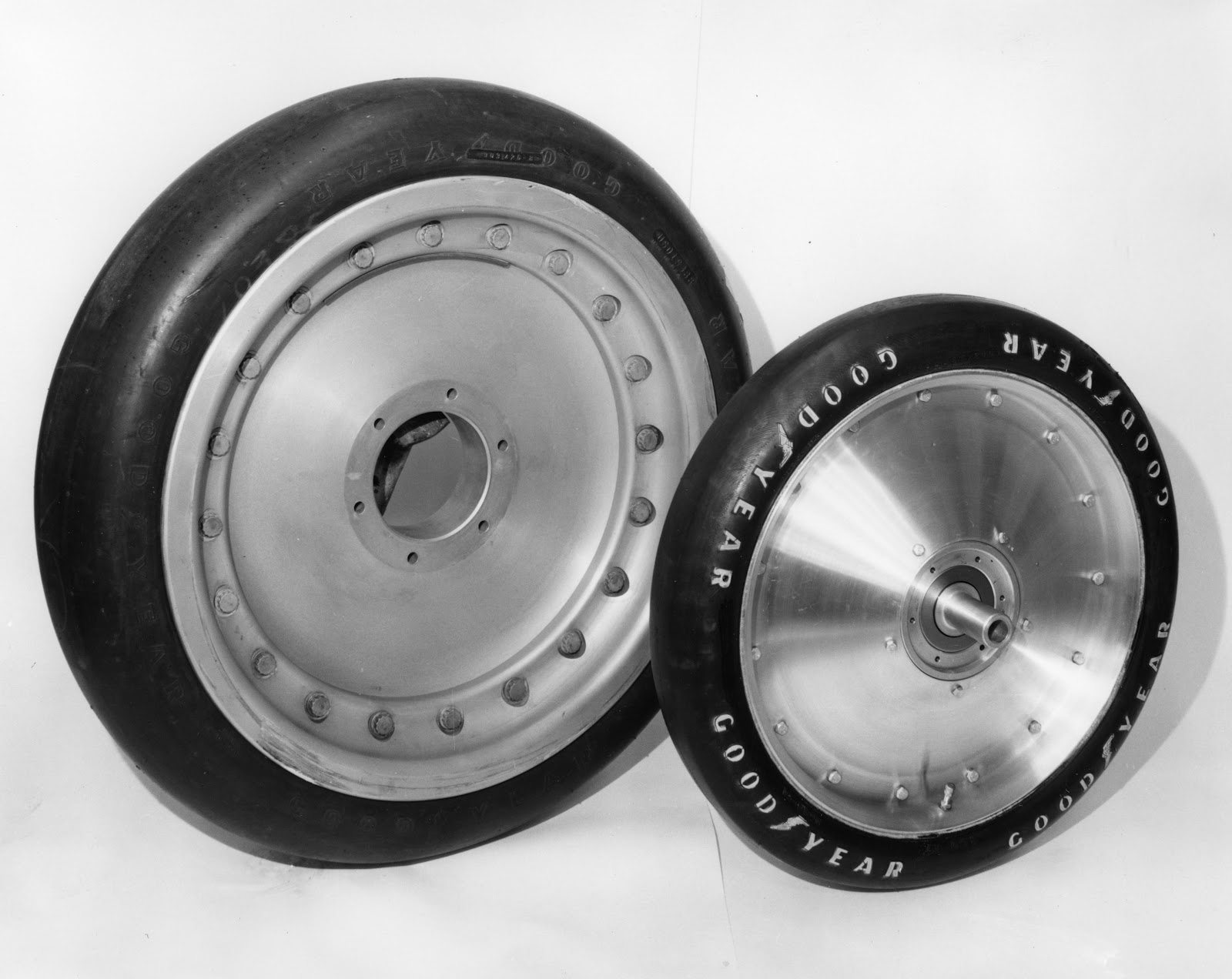
The Hawk would roll on custom three-piece wheels of 19-inch diameter, spun from 1/4-inch aluminium by Cragar Industries. The two discs would be sealed with a giant O-ring to accommodate Goodyear LSR tubeless tires and withstand pressures of 120 psi, and was tested up to 350 mph. 


The Honda Hawk Streamliner was also going to be the test bed for a new type of toothed chain known as "Hy-Vo," that would be stronger and more efficient than conventional roller chain, and be so bulletproof as to defy at least a dozen crashes at various speeds up to and over 200 mph without serious damage or deformation.


Monday, 23 April 2012

Honda Hawk Streamliner Week – Post: 02


The Honda Hawk

By
Dick Keller


The first glimmer of the Honda Hawk occurred when I met Burt Munro in 1968 on the Bonneville Salt Flats. Mickey Thompson had invited me to observe his successful attempts at setting numerous FIA land speed records with the Mach 1 Mustangs. Burt also was there and we talked for several days about his adventures as I looked over his ancient Indian streamliner. It really looked much better in the film, “World’s Fastest Indian”, than on the salt that week.


After that experience I sketched some ideas in my spare time at Reaction Dynamics with the idea of eventually building a bike around a pair of Kawasaki triples. Fascination with the motorcycle land speed record grew while on the Salt Flats in 1970, watching Don Vesco set the FIM record at 251.66 miles per hour, followed days later by Denis Manning’s Harley-Davidson, ridden by Cal Rayborn, to 254.84 miles per hour. 

Don Vesco - Twin Yamaha 350cc

Dennis Manning - Harley-Davidson streamliner

The whole Honda Hawk design and construction took place in about six months in 1971. American Honda was interested in the FIM record and asked Pete and me to build a bike to race that year. The results were a one way run in 1971 at 286.7 miles per hour and, in 1972, an AMA class record of 232.7 miles per hour. Not too shabby, eh? 


Arriving on the Salt Flats in late September, it immediately became apparent I had screwed up the steering geometry. A four bar link design was employed to try and keep the steering structure rigid at design speeds over 300 miles per hour. While the Honda Hawk did fall over a few times at low speeds, compared to Manning’s tank-slappers in 1970, it didn’t look too bad. By the time Rayborn set his record with the Harley it could have been called the Duct Tape Special. Stuff happens when you push the envelope, and if you are prudent it isn’t fatal, just a learning experience. Manning and Rayborn stuck with it and won!

After getting some bearing part numbers from Don Vesco (a really great guy) we quickly redesigned the steering using a “center-point” design. Dix Erickson hustled back to American Honda to fab the parts and we got it rolling immediately. It never fell after that in 1971.

The major problem following the handling issue concerned the condition of the race course itself. I-80 was under construction, built on a berm of earth, rocks, etc., alongside US40. During the winter of 1970-1971 debris consisting of mud and clay washed out on to the international course. When the summer wind and heat dried the Salt Flats, the debris was blown away leaving a veritable motocross surface – well, not quite, but undulations remained in the high speed sections.


Honda Hawk had a fixed rear suspension. As a result, at high speeds the rear wheel left the ground. We continually had two modes of failure on several record attempts, both related to over-revving the motors. While the motorcycle did have a rev limiter, it didn’t work. Solid state electronics were temperature sensitive in those days. The rev limiter was calibrated in the dynamometer lab at higher temperatures than the frigid conditions in October in the high desert. The result was disastrous.


At high speeds the rear tire would unload and the motors would rev up before Jon McKibben could roll back the throttle. Several times this resulted in bent valves when they floated and hit the pistons. Other times, when the rear wheel was over-speeding in the air it came down and overloaded the drive chain which stretched or snapped. It was not possible to make the FIM-required reverse direction runs in the time available. Finally, the racing season was over.


At this time American Honda took over the Honda Hawk program in Gardena. Several changes were made to the Honda Hawk’s front and rear suspension. It crashed, at speed this time, in 1972 after setting the class record – which still stands.


I am not embarrassed that we built a unique bike in six months that went over 30 miles per hour faster than the FIM land speed record.


Dick Keller – 10/03/2010


Honda Hawk Streamliner Week – Post: 01


Want a better story on the Honda Hawk streamliner?

It is the 28th februarry 2012, and I am checking my mailbox, and one particular e-mail interests me! The title is "Want a better story on the Honda Hawk streamliner?", send to me by someone called Richard (Dick) Keller??? 


After a fast google search it looks like this "somebody" must be the Richard Keller from Reaction Dynamics, that was involved in The Blue Flame land speed record attemt in 1970!?! What is going on??? The e-mail is a reacktion to a post on COFDL that I posted exactelly a year ago to this day! 


I heard of the Honda Hawk streamliner from a classic swedish motorcycle magazine, making an anniversary issue on the Honda CB750. In that magazine there was a very short story on a land speed record made with a CB750 twin engined streamliner, a story of the fastest CB750 ever, and hardly anyone has ever heard about it...?   


This week will be entirely dedicated to The Honda Hawk Streamliner, and thanks to Mr. Keller contribution, you will have the very rare opportunity to have a look into one of the largest online photo collections on the Honda Hawk Streamliner. 

The letter from Dick Keller containing 2x CD's with 
the pictures from the record attemt


Friday, 20 April 2012

Honda CB750 - Owners Manual


Don’t Hesitate To Get Out There!

Yes there are deers in the forest ahead! F*ck it, and throttle it...


Bullshit Detector by Baby Woodrose

I am seriously considering to make a black book with names of people I want to kick in the F*CKING balls!!! 
Or maybe I just need to invest in a Bullshit Detector